
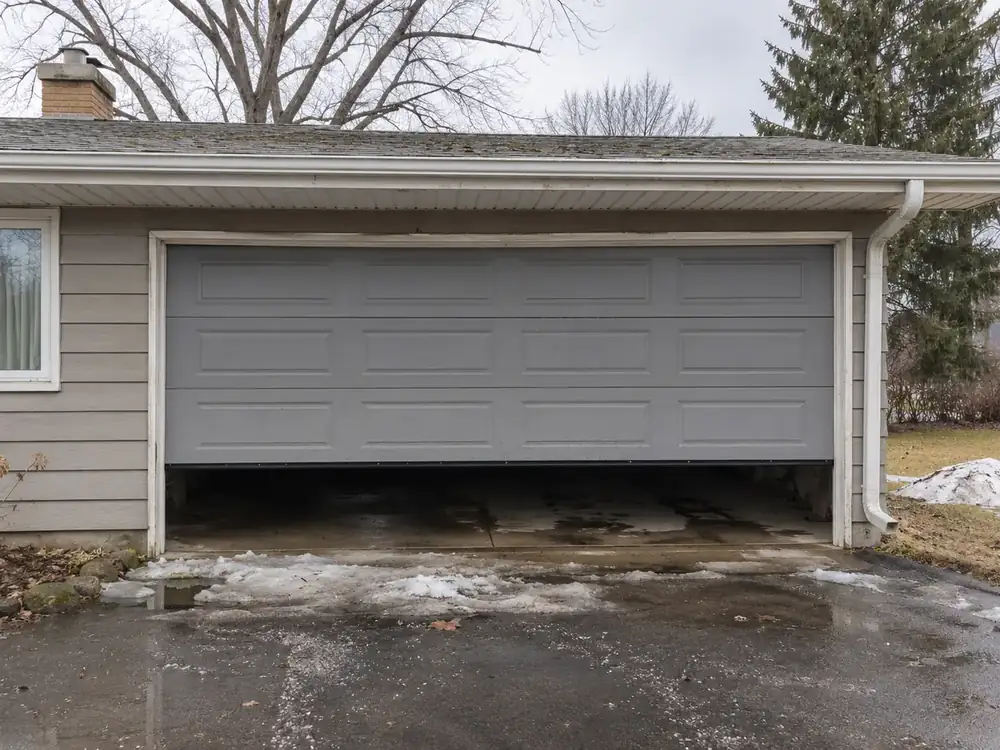
When winter brings a door that won't move, garage door problem solving starts with keeping people clear and describing the symptom during a call.
A Door That Stays Fully Closed
After an icy night, a door that won't lift may have a frozen seal, a broken spring or an opener that isn't receiving power.
- Call without trying to force the door; describe any bang, motor hum or visible gap in the spring above the opening.
- From a safe position, look for an unplugged opener cord or an unlit wall control; leave electrical covers and wiring closed.
- Genie's safety page says not to move a door manually or by opener when a spring is broken; the visit checks the lifting system before further operation.
Remotes and Wall Controls Can Give Clues
On a cold morning, a remote that does nothing may point to a battery or control setting rather than a failed door motor.
- With the door closed and undamaged, check the remote battery and the wall control's lock switch using the model's instructions.
- Share whether the wall control responds while the remote doesn't; don't keep testing a door that strains, jerks or binds.
- If the motor runs without moving the door, the emergency release may have disconnected the trolley; leave reconnection to your technician when the door's condition is uncertain.
- Your technician tests the controls and connection, then distinguishes an access-control fault from a mechanical failure.
Reversing Doors Need Sensor and Threshold Checks
When snow gathers at the opening and the garage door won't close, an obstruction or blocked photo-eye beam can interrupt closing.
- From outside the door's path, look for snow across the threshold and frost, a smudge or a tilted photo eye near the floor.
- With the door fully closed and opener unplugged, gently wipe accessible sensor lenses with a soft dry cloth; don't move brackets or bypass the sensors.
- Genie's troubleshooting instructions explain that clean, aligned photo eyes must see each other; the visit checks alignment and closing travel.
Frozen Seals Need Careful Assessment
After meltwater freezes again, a bottom seal stuck to the slab needs assessment without pulling or chipping the door loose.
- Don't pry at the bottom section, use a sharp tool on the seal or increase opener force to break the bond.
- The National Weather Service's Rochester winter summary describes regional freezing and mixed precipitation; weather alone doesn't establish why a particular door stopped.
- Your technician checks the seal, threshold and door movement, then addresses the obstruction or damaged part responsible for the sticking.
A Crooked or Partly Open Door Needs Repair
Following a snowy day, a door that stops unevenly needs off-track door repair assessment without another attempt to move it.
- Impact, damaged rollers or a cable fault can explain what causes a garage door to come off track; snow near the opening doesn't establish the cause.
- Keep people out from under the door; unplug the opener only if the plug is reachable without entering the opening or climbing.
- Don't pull the emergency release on a crooked or partly raised door: 16 CFR 1211's user instructions say to use the emergency release only when the door is closed if possible; weak or broken springs may allow the door to fall rapidly.
- Leave springs, cables, drums and bottom brackets untouched; garage door problems involving lifting hardware need controlled professional work.
- One of our local garage door partners will explain the necessary repair and its charges before work starts; the visit restores alignment and checks operation.